Born in Someone Else's Shoes: How Playing a Role You Didn't Write Can Set You Free
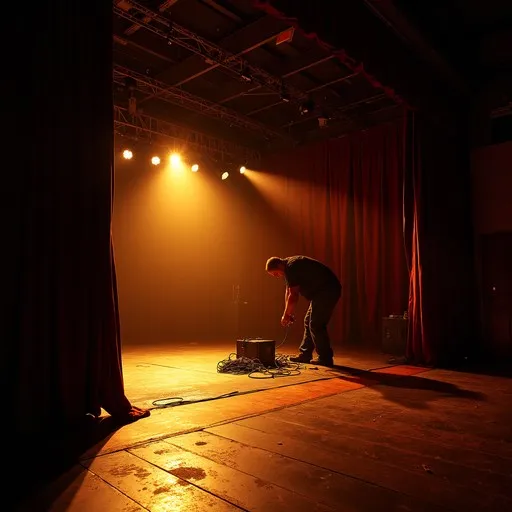
Photo: performer backstage wings of theater watching stage spotlight dramatic, via images.stockcake.com
The Part That Wasn't Yours
Ask almost any working actor, dancer, or stage performer about their understudy years and you'll get one of two reactions. Either a slightly pained laugh and a quick subject change, or a slow, thoughtful pause — the kind that signals they're about to tell you something they haven't quite put into words before.
Understudying has a reputation problem. In the popular imagination, it's a consolation prize, a holding pattern, the role you take when you couldn't land the real thing. But spend any time talking to performers who've been through it — really been through it, not just technically listed as a backup — and a more complicated picture emerges. One where the constraints of someone else's role turn out to be surprisingly generative. Where learning to inhabit a character that wasn't built for you ends up revealing something you couldn't have found any other way.
The Paradox of the Established Role
When you're creating original work, you have complete freedom and no guardrails. That sounds ideal, but freedom without constraint can be its own kind of paralysis. The blank page, the open stage, the character with no established history — these demand that you invent everything from scratch, which means every choice is a negotiation with your own uncertainty.
Stepping into an established role inverts all of that. The character exists. The blocking may be set. The audience — or at least the production — has expectations. You're working inside a structure you didn't design, and your job is to make it yours without breaking it.
That tension, it turns out, is creatively electric.
Jennifer Holliday's original performance of "And I Am Telling You I'm Not Going" in Dreamgirls became one of the most celebrated moments in Broadway history. Every performer who has stepped into that role since has had to wrestle with a specific question: how do you honor what made it legendary while bringing something that is genuinely, authentically you? The answer to that question — the process of working through it — has produced performances that are, by some accounts, more emotionally transparent than the performer might have achieved with entirely original material. The role becomes a kind of mirror.
Constraints as Creative Engine
There's a concept in improvisation called "the gift" — the idea that a constraint or an unexpected offer from a scene partner isn't a problem to solve but a gift to accept and build from. Understudy work operates on a similar principle. The established role is the gift. What you do with it is the performance.
Musical theater is full of stories about understudies who went on and found something in a role that the original performer hadn't quite located — not because they were more talented, but because the fit was different, the angle was fresh, the interpretation was unclouded by the choices that had calcified over months of performance. The distance between "this role was built for someone else" and "this role is showing me something about myself" can be surprisingly short.
Dancers talk about this too. Learning a piece of repertoire choreographed for a different body type, a different era, a different set of technical assumptions — it forces a kind of creative problem-solving that purely original work doesn't require. You're not just executing movement. You're translating it. And in that translation, you develop a relationship with your own physicality that you couldn't have engineered directly.
When the Understudy Becomes the Story
The cultural mythology around understudies tends to focus on the dramatic last-minute call — the star is out, the understudy goes on, the audience doesn't know what they're in for. And yes, those moments are real, and they are genuinely high-stakes in a way that's hard to overstate. But the more interesting story, for most performers, isn't the night they went on. It's the months before it.
Learning a role you may never perform publicly changes how you study. You're not building toward a premiere. You're not getting director's notes shaped specifically for you. You're doing the work in relative isolation, making interpretive choices that may never be tested in front of an audience. That process demands a kind of internal clarity — a commitment to understanding why a character does what they do, not just what they do — that can be transformative.
Many performers describe coming out of understudy periods with a significantly more rigorous approach to character work. The experience of learning someone else's performance from the outside in forces you to ask questions you might otherwise skip when building a role from scratch.
Finding Your Voice Through Someone Else's Words
There's something almost counterintuitive about the idea that imitation can be a path to authenticity. We're conditioned — especially in American creative culture, with its emphasis on originality and individual expression — to think of influence and imitation as things to move beyond as quickly as possible. Get in, absorb what you need, and get out before it starts to show.
But some of the most distinctive artistic voices in performance got there through prolonged, serious engagement with other people's work. Not as a shortcut, but as a kind of apprenticeship. The process of fully inhabiting a role that wasn't written for you — of making genuine, committed choices within someone else's framework — teaches you where your instincts actually live. What you reach for when you're working within constraints is often more revealing than what you choose when everything is on the table.
The understudy's moment isn't just the night the phone rings and you go on. It's every rehearsal, every private run-through, every time you ask yourself how you would play this, even knowing you might never get the chance. That question — asked seriously, answered honestly — has a way of shaping everything that comes after.
The Role That Made You
For performers willing to take it seriously, the understudy experience is one of the stranger and more valuable things the industry offers. It's a chance to do the full creative work of inhabiting a complex role without the pressure of being the primary interpretation. It's a chance to fail privately, to experiment without consequence, to find your own relationship to material that already has a history.
And sometimes — not always, but often enough to matter — the performer who comes out the other side has a clearer sense of who they are artistically than if they'd been handed an original role from day one. Borrowed shoes, it turns out, can take you somewhere entirely your own.