When Two Becomes Something Else: The Strange, Revealing Truth About Creative Collaboration
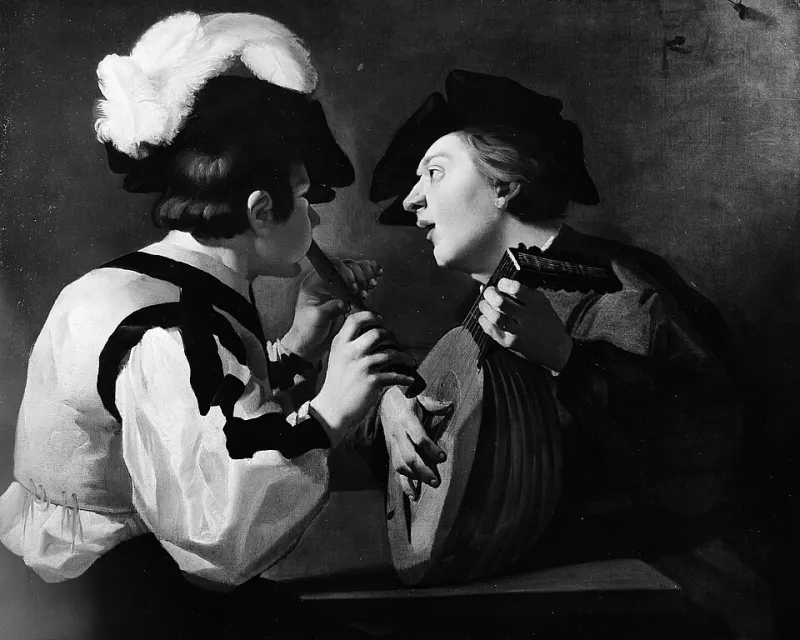
Photo: anonymous , CC0, via Wikimedia Commons
Here's something nobody really warns you about when it comes to creative collaboration: it's one of the most effective mirrors you'll ever look into. Not because your collaborator will tell you things about yourself — though sometimes they will — but because the work itself will. The decisions you make when someone else is in the room, the things you hold onto and the things you let go, the moments you dig in and the moments you defer — all of it adds up to a pretty honest picture of who you are as an artist.
And that can be uncomfortable. It can also be extraordinary.
The Solo Illusion
Most creative people, if they're being honest, develop a fairly specific self-image through their solo work. You get comfortable with your instincts. You know your tendencies, your aesthetic preferences, your process. You build an identity around what you make and how you make it.
Then you walk into a room with another creative person, and suddenly half of those certainties are up for negotiation.
This is the paradox at the center of collaboration: the thing that feels like it might dilute your artistic identity often ends up clarifying it. Because you can't really know what you're committed to until someone challenges it — not out of malice, but just by virtue of having different instincts and a different vision.
Solo work lets you stay comfortable. Collaboration doesn't.
Choosing a Collaborator Is Choosing a Self-Portrait
One of the most underappreciated aspects of collaboration is the decision of who to work with. In theater, in music, in visual art — across every creative discipline — the choice of collaborator is itself a creative statement. It reveals your priorities, your ambitions, your blind spots, and sometimes your ego.
Think about some of the more unexpected pairings that have defined American creative culture. The classical composer who teams up with a hip-hop producer. The performance artist who invites a data scientist into their studio. The Broadway director who casts an actor completely outside the conventional mold for a role. In each case, the collaboration doesn't just produce something new — it signals something about what each artist values more than their own comfort.
When a musician known for meticulous studio control chooses to record live with a jazz ensemble, they're not just making an aesthetic choice. They're making a statement about what they're willing to risk. And that risk-taking, or the absence of it, tells you a lot.
Where the Real Tension Lives
The most revealing moments in any collaboration tend to happen not in the easy, generative early stages — when everyone's excited and the ideas are flowing — but in the friction. The disagreement over a direction. The moment when one person's vision pulls against the other's. The creative impasse that forces both parties to figure out what they actually care about.
Those friction points are where character shows up. Does an artist double down on their original concept, or do they genuinely listen? Do they make space for an idea that's different from their own, or do they subtly steer everything back toward familiar territory? Are they collaborative in name only, or do they actually share authorship?
The answers to those questions aren't just about working style. They're about artistic identity at a pretty fundamental level.
What Neither Could Have Made Alone
The most compelling argument for collaboration isn't efficiency or exposure or even creative stimulation — it's the specific category of work that can only exist between two people. The thing that emerges from the overlap of two distinct sensibilities, that couldn't have come from either artist working independently.
This is what the best collaborations actually produce: not a compromise between two visions, but a third thing. Something that belongs to the partnership more than it belongs to either individual.
You can hear it in certain albums — records where you can't cleanly separate the contributions and wouldn't want to. You can feel it in certain theatrical productions where the direction and the performance have merged into something indivisible. You can see it in visual collaborations where the work resists easy attribution. That third-thing quality is rare, but when it happens, it's unmistakable.
The Vulnerability Factor
There's a reason a lot of artists resist collaboration even when they're curious about it: it requires a particular kind of vulnerability that solo work doesn't. You have to be willing to be seen in the process, not just in the product. You have to let someone else watch you figure things out, make mistakes, change your mind.
For artists who've built their identity around a strong, consistent aesthetic — and in the American entertainment landscape, that consistency is often what gets you recognized and rewarded — collaboration can feel like a threat to that identity. Like you're diluting something that took years to build.
But the artists who lean into that vulnerability tend to find something on the other side of it: a fuller understanding of their own creative instincts, because those instincts have been tested. They know what they'll compromise and what they won't. They know what they're actually committed to versus what they just defaulted to because no one was pushing back.
What the Partnership Leaves Behind
Even when collaborations end — and many do, some messily — they tend to leave a permanent mark on how each artist works afterward. You carry the residue of another person's way of seeing into your next solo project. You ask different questions. You hold your initial ideas a little more loosely, because you've experienced what happens when you do.
In that sense, collaboration doesn't just produce a single piece of work. It changes the artist who made it. And that might be the most interesting thing it does.
Working with someone else doesn't tell you who they are as much as it tells you who you are — what you protect, what you're willing to explore, and what you're capable of when your usual creative habits get disrupted by the presence of another human being with their own vision and their own stubbornness and their own genius.
That's not a small thing. That's the whole thing.